Knees Aching, Stride Stuttering? Your Orbitrek Was Probably Fitted for Someone Six Foot Three
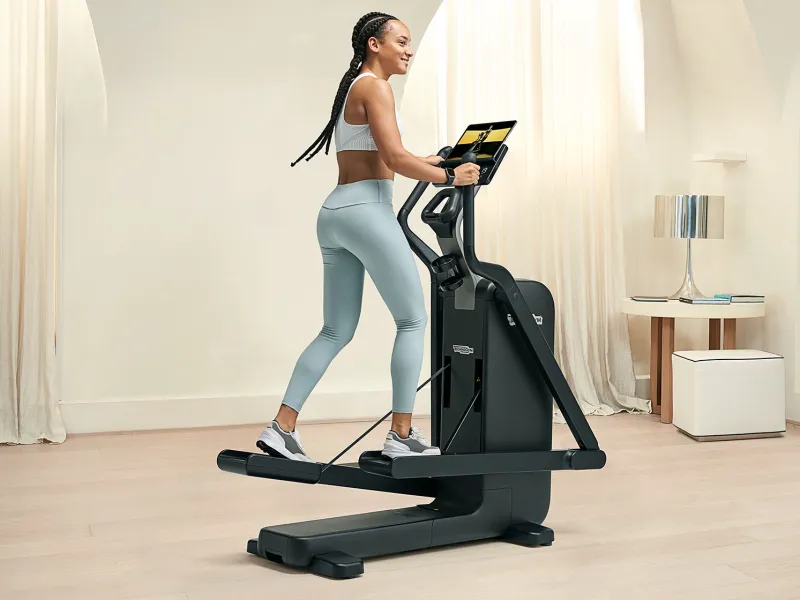
Photo: woman adjusting elliptical trainer home gym side view, via images.ctfassets.net
Ever hopped off your orbitrek after twenty minutes wondering why your knees feel like you've run a half marathon on cobblestones? Or noticed your stride feels less like gliding and more like a fairground ride designed by someone who hates you?
You're not imagining it. And you're probably not doing anything wrong either.
The Height Problem Nobody Mentions in the Showroom
A huge chunk of the machines sold in Britain are designed, engineered and tested in the United States, where the average man stands around 5'9" and the average woman 5'4" — but where the design benchmarks for fitness kit often skew taller still. Add to that the fact that many brands set their machines up for showroom floors rather than sitting rooms, and you get orbitreks whose stride length, pedal spacing and flywheel position simply don't suit a lot of British bodies.
The result? A machine that technically works, but feels wrong in a way that's hard to articulate. You shorten your natural gait to fit the machine. Your knees track oddly. Your heels lift. The whole thing feels like walking in someone else's shoes — because, mechanically, it is.
What Stride Length Actually Means (And Why It Matters)
Stride length on an orbitrek is the distance between the furthest forward and furthest back position of the pedal. Get it wrong in either direction and your joints pay for it:
- Too long for your legs, and you end up overreaching — hips rocking, knees twisting slightly at full extension, lower back taking strain it never asked for.
- Too short, and your movement becomes a stilted shuffle. You'll burn fewer calories, feel the burn in your quads instead of your whole leg, and get bored stiff because it just feels... flat.
As a rough guide, people under 5'3" tend to suit strides of 14–16 inches. Between 5'4" and 5'10", you're looking at 17–19 inches. Over 6 foot, 20 inches or more. But these are starting points, not gospel — proportions vary, and feel matters more than a chart.
Pedal spacing matters too. If the pedals sit too far apart, your hips splay outward and your knees drift inwards on each stroke. This is the classic cause of that vague, niggly knee ache that shows up a day after your session.
The Mirror Test: Diagnosing Your Stride for Free
You don't need a biomechanics lab. You need a wall, a mirror and your phone.
- Set up side-on to a full-length mirror. Position your orbitrek so you can see your profile, or prop your phone up filming from the side at hip height.
- Pedal at a slow, natural pace for two minutes. Don't perform — just move the way you normally would.
- Watch four things:
- Do your knees stay stacked over your feet, or do they wobble in and out?
- Do your heels stay planted, or lift at the back of the stride?
- Do your hips sway or bob?
- At full forward extension, is your front knee still slightly bent, or locked straight?
Locked knees at full extension is the smoking gun for a stride that's too long. Heel-lifting and knee-wobble usually point to a stride that's too short, or pedal spacing that's too wide. Film it — you'll spot things in playback that you simply can't feel mid-workout.
Fixes That Cost Nothing
Before you blame the machine entirely, work through these:
Adjust the incline or ramp (if you have one). A higher incline effectively shortens the horizontal stride and shifts work to your glutes. If your stride feels too long and flat, raising the ramp can transform it.
Move your feet on the pedals. This sounds daft, but pedal placement is the most overlooked free fix. Slide your feet forward on the pedals to effectively lengthen your stride; slide them back to shorten it. Many people stand with their toes overhanging the front edge out of habit — shifting back an inch can settle your whole posture.
Check the levelling. A machine that rocks even a millimetre changes your stride path. Grab a spirit level, check the rails, and wind out the adjustable feet. A folded beer mat under one corner has fixed more wobbly orbitreks than any engineer.
Revisit resistance. A stride that feels wrong at low resistance often feels smooth at moderate resistance, because momentum carries you through the arc rather than you muscling it. Try level four or five before writing the machine off.
When It's Genuinely the Machine
Some budget orbitreks — particularly older rear-flywheel designs with fixed 12- or 13-inch strides — simply can't be fixed. If your inside leg measurement is over 30 inches and your machine's stride is under 14, no amount of foot shuffling will save you.
If you're shopping rather than diagnosing: look for adjustable stride (usually 17–20 inches), front or centre flywheels for a flatter, more natural pedal path, and pedals that articulate or sit reasonably close together. Test in person if you possibly can, and do the mirror test within your returns window.
The Bottom Line
An orbitrek that fits you should feel almost boringly smooth — no joint complaints, no awkward reach, just steady rhythm. If yours doesn't, work through the free fixes first. And if it still fights you after that, it's not a discipline problem or a fitness problem. It's a fitting problem, and life's genuinely too short to spend it striding in the wrong size machine.